
What are AI agents, and what can they be used for?
What You Should Know
AI is rapidly transforming the technology industry and beyond, introducing numerous new concepts and ideas. Lately, the AI Expedition team has been discussing agentic AI.
In a nutshell, an AI agent is a program that can independently complete tasks. An agent uses a model (typically a large language model/LLM) to autonomously make decisions, interpret the input given to it, plan how to move forward, and take actions from there. The LLM is the brain that helps the agent understand its environment, enables better reasoning on multi-step problems, and more accurately plans to achieve the requested result. An agent also has the capability to correct and learn from its mistakes, storing past conversations and plans in memory. It doesn’t necessarily require step-by-step instructions and can take action to achieve any goal set for it without human oversight.
The agent goes through four phases as it works:
- Perceive
Calls on the training data to collect more information; sifts through that data to determine what’s relevant to the task at hand
- Reason
Interprets the user input and any additional context it has access to; comes up with a plan to achieve a goal or get a result
- Act
Follows that plan and does the things
- Learn
Gets feedback from other agents, models, and/or humans to fine tune the output and workflow (this is usually where “tweaking” the output happens)
Pros and Cons
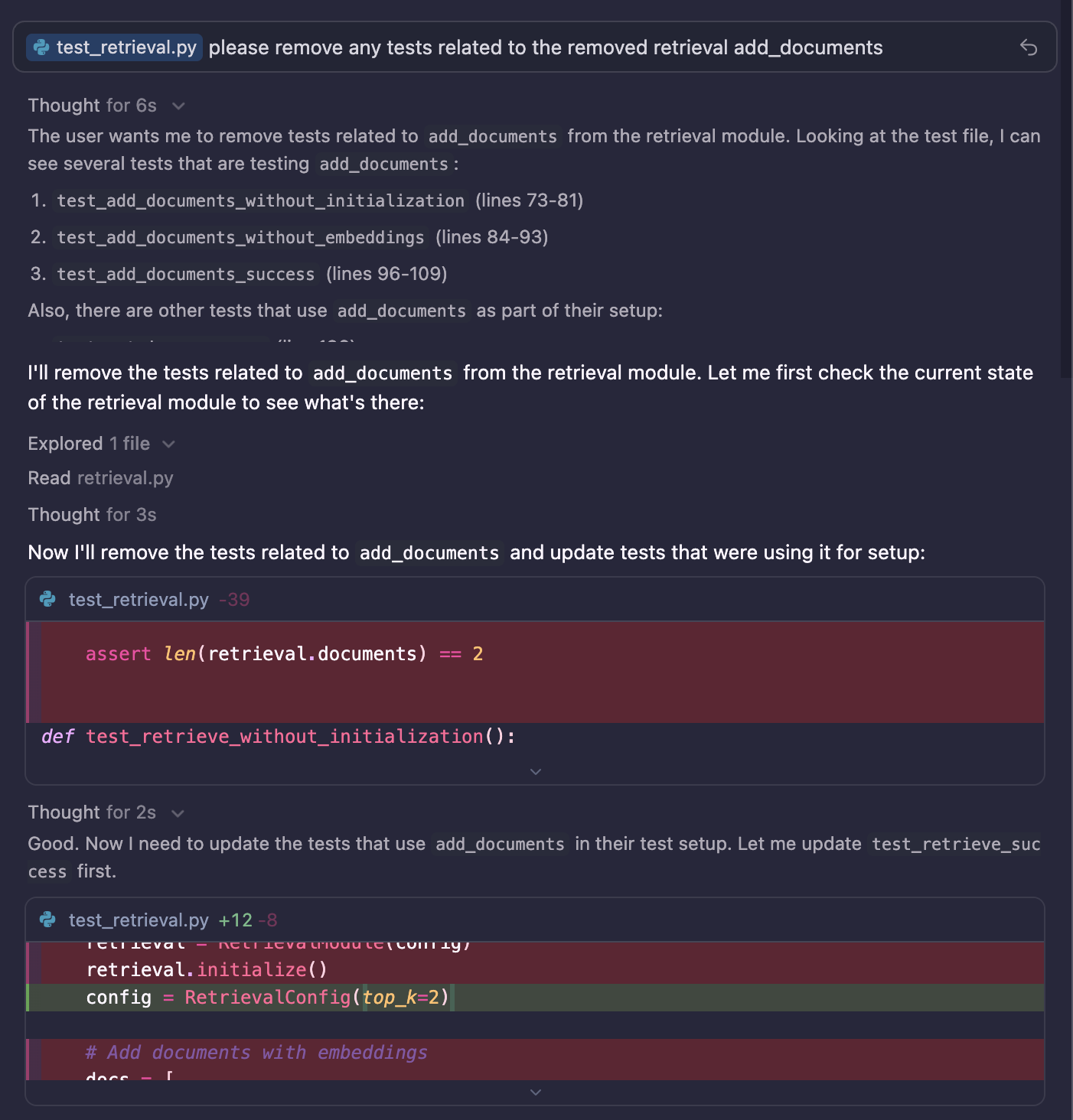
If you’ve used ChatGPT’s or Cursor’s agent modes, you may have noticed they can get from point A to point B without much help from you. But what are the pros and cons to using agentic AI tools?
Pros
The agent’s ability to perform multi-step processes could reveal opportunities for efficiency gains, particularly for well-defined, easily repeatable tasks.
Because an agent requires little human intervention, the risk of common mistakes due to “human error” can be reduced.
Agentic AI products can traverse, process, and handle massive datasets much more easily than a human team.
Agents have the capability to learn from their mistakes, so over time, they are trained to perform better based on feedback given to them.
Cons
Security concerns (such as the supply chain attacks on NPM) are a real possibility when the agent simply does the task, often without asking the questions an experienced human would.
Because an agent doesn’t need much human intervention, reworking the agent’s mistakes is a very real side effect, since a lot of models used by agents still hallucinate (or confidently invent information).
Training data that isn’t diverse can cause the agent to inherit biases, leading to unwanted outcomes (like unintended discrimination during a hiring search).
If an agent acting autonomously makes a mistake, it can be difficult to understand how that mistake was introduced, and where responsibility for the correction should be placed.
Agents and agentic AI can offer productivity boosts to almost every aspect of the tech industry. Those productivity boosts, however, should always have a human verifying the work and its quality.
Tools We’re Looking At
The AI tooling ecosystem grows on a daily basis. Here are some of the agents we’ve been experimenting with, and what productivity enhancements they provide.
Development
Cursor: Specific agent designed to handle multi-step coding tasks, built into a code editor.
Claude Code: Although not a standalone coding agent, its coding capabilities allow thorough repository understanding and indexing.
Devin: “Junior engineer” capable of taking a task from concept to code.
UX Design and Research
ChatGPT Agent: Highly effective at streamlining research and design ideation.
Zapier AI Agents: Configurable agents that monitor triggers (like new user feedback) and take multi-step actions (classify, summarize, route, and notify).
n8n: Allows users to build agentic flows using AI actions + triggers + loops.
Other Industries
Zendesk (customer service): AI-powered automated support bots are built into the Zendesk customer service platform.
Otter (project management): Get transcripts, automated summaries, action items, and chat with Otter to get answers from your meetings.
Fireflies.ai (project management): Joins meetings via calendar invites, and will record, transcribe, summarize, and analyze meetings across platforms like Zoom, Google Meet, Microsoft Teams, Webex, and even non-video calls.
What Are You Curious About?
Ask Sparkbox about how AI might be valuable to your organization.
Watch this space for monthly updates on what we’re exploring, what we’ve learned, and what’s next. And if you have ideas or questions, we’d love to hear from you.